
ADHD and Routines: Why Structure Helps Your Brain (and How to Build One)

Rick Rescorla, a decorated Vietnam veteran, was head of security for Morgan Stanley at the World Trade Center. After the 1993 World Trade Center bombing, he believed that the towers remained targets. He instituted strict, mandatory and repeated evacuation drills, which some employees didn’t appreciate. On 9/11, when told to stay in place in the towers, he ignored orders and organized an immediate stairwell evacuation for Morgan Stanley. He kept people calm and boosted morale by singing Cornish folk songs to them, much as he did in Vietnam. His preparation saved all but 6 of the 2,700 employees that day. What an incredible example the power of routine. It was preplanned and drilled with consistency until it became automatic, helping people perform in a crisis situation.
What is a routine?
A regular fixed way of doing things in a specific order
A habitual or mechanical performance of an established procedure
Commonplace tasks, chores or duties as must be done regularly or at specified intervals, typical or everyday activity.
How does it make a difference?
If you are like me, you might be wanting to scream after reading these definitions! The bottom line is that a routine allows you fly on automatic pilot, and you don’t have to overthink anything. It is a pattern that is mentally rehearsed. It saves energy, reduces stress, lifts the weight of decision making and allows a person to make healthy choices.
Why is a routine necessary for people with ADHD?
ADHD is a disorder of self-regulation and executive function. Those are the mental skills necessary to plan, prioritize and manage time. We live in the now and have a hard time thinking into the future. Our intentions don’t always translate into action. It’s not that we don’t know what to do, it’s doing what we know to do! It is why ADHD is sometimes referred to as a “performance disorder”. A routine reduces mental exhaustion, as well as anxiety. It helps us to get started. It is preplanned, predictable and flexible. We stay on time because we are successfully navigating a transition.
A routine has been called an external scaffolding or support that compensates for higher thinking skills. I remember a prominent coach who put such a support in place with his son who was going to college. Their agreement was that if he was going to spend a thousand dollars or more that he would call his dad first. The young man was all set to buy a car at a dealership. He remembered the agreement with his dad and called him from the rest room. The dad said that he could get a better price on the car elsewhere, and the young man saved money in the process, all because they had a structure in place ahead of time.
If routine matters, why do people with ADHD resist it?
We fear an imposed structure that is not our own.
We tend to be divergent thinkers and going step by step seems foreign and tedious (ordering things or sequencing is an executive skill).
We tend to be reactionary versus intentional. We are used to chaos.
We pride ourselves on keeping everything in our head, we don’t need “props.”
We fear being “restricted,” thinking we can get more done than we actually can.
All of the above are the very reasons we need routine!
“Daily habits make ADHD easier, but symptoms and executive functioning challenges make it hard to establish and consistently follow routines.”
— Sharon Saline, PsyD.
Create a routine the ADHD friendly way!
Keep your routine simple. Here’s how to create a routine that works.
As you time the steps of your routine, you will become much better at estimating time.
Reward yourself when you complete your routine.
Notice the difference a routine makes. What is the payoff?
Lose perfectionism and all or nothing thinking. Give yourself grace.
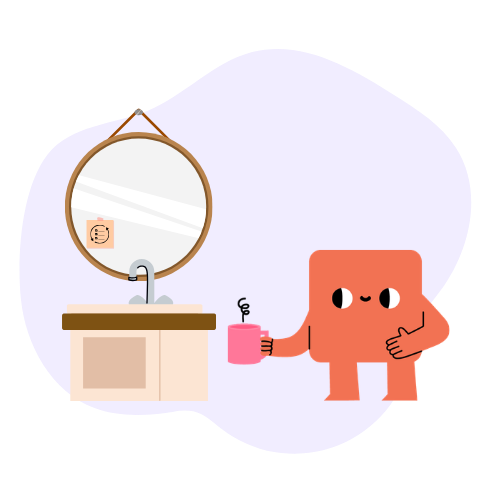
Jazz up your routine. Write it on your bathroom mirror. Create a song loop that keeps you moving from step to step.
Cushion your routine with an extra 10 minutes. Build in success.
Be aware of the tendency to get distracted. Just because you think something doesn’t mean you have to do it!
Make your routine a priority. A priority is a boundary that keeps some things in and other things out (when kids use bumpers in bowling, it helps the ball hit its intended target).
A routine is a wonderful tool that simplifies life with ADHD. It provides the stability and predictability we crave. A routine has the power to stimulate, not suffocate! When on the clock, a routine can truly save the day! It smooths transitions, relieves stress and supports reaching goals.
We manage time better and actually get to work early, so we can collect ourselves and get ready for the day. We no longer play “beat the clock,” getting more anxious by the minute. We become more intentional and less reactionary. We reward ourselves because it honors the fact that creating change is hard. Our routines lead to better physical and emotional health. We focus better and are more productive. We no longer worry about goals because we have the habits in place that lead to our goals. We calm our brains and create a little peace in our lives. We experience a sense of security versus feeling out of control. We are empowered!
Create a routine today and see the difference it makes! You’ve got this!
For partnership in creating a routine that works, click here.
Resources
The Importance of Creating Habits and Routine - The National Institute of Health, www.pmc.ncbi.nim.nih.gov
A Daily Routine Can Boost Your Mental Health - www.uclahealth.org
Finding Focus and Balance: Establishing a Routine to Cope with ADHD - www.sagementalwellness.com
Routines That Work for Adults with ADHD - Brieanna Scolare, www.aspiretherapy.com
5 Reasons Why Routines Fizzle and How to Rekindle Healthy Habits - Sharon Saline, PsyD., www.additudemag.com