
Finding Hope with ADHD: How to Persevere Through Life's Toughest Moments

Have you ever had the rug pulled out from under you? You weren't expecting it, and you fell without being able to protect yourself. You slowly got up, battered in body and soul — dazed, trying to make sense of it all. Your self-esteem is in tatters and you wonder, what now?
How do you navigate uncertainty and move forward when your confidence has taken a hit?
Maybe you've lost a job. Maybe a relationship ended. Maybe you've recently received a challenging diagnosis. Whatever the circumstance, we all need hope — the belief that life will once again be good.
Psychologist Everett Worthington put it this way: "Hope is the motivation to persevere toward a goal or end state, even if you are skeptical that the positive outcome is unlikely."
Author Darren Brown echoed that idea: "Our perseverance will get us through any difficult situation that we might be going through, however perseverance is useless by itself — it needs hope. Hope inspires us with strength and lends power to our perseverance, so that we can traverse our difficulties with more grace. We need to keep moving forward and keep our faith!"

What Is Hope and Why Does It Matter?
Hope isn't just a feel-good emotion. It has measurable effects on how our brains function.
When you experience hope during a time of challenge, your brain actually performs better. You're more likely to make positive decisions. Hope dials down the anxiety circuits in the brain, and when you're less anxious, your cognitive function improves.
But the flip side of hope is fear. As psychiatrist Brian Lawlor, MD, Founding Director of the Global Brain Health Institute at Trinity College Dublin, explains:
“The flip side of hope is fear, and sometimes fear and despair are easier to fall into than hope. Fear disempowers hope and paralyzes action by activating the anxiety and fear pathways in our brains."
- Brian Lawlor, MD

So what does hope actually look like? Researchers have identified four core characteristics of hope:
Envisioning a better future
Wanting that future and feeling driven to achieve it
Believing it is possible
Having the ability to keep going in the face of challenges
Every time you face a challenge and come out the other side, you are one step closer to achieving your goal.
"Hope is being able to see that there is light despite all of the darkness."
— Desmond Tutu
"We must accept finite disappointment, but never lose infinite hope."
— Martin Luther King Jr.

Why Is Hope Especially Important for People with ADHD?
If you have ADHD, holding on to hope can feel uniquely difficult — and that's not a character flaw. It's rooted in the way the ADHD brain works.
The ADHD brain struggles to imagine a positive future because the current painful situation feels as if it will never end. Sitting with the accompanying feelings is incredibly hard. Will things ever get better?
Many of us with ADHD carry additional weight that makes hope harder to sustain. We may have experienced past trauma from repeated failures or perceived failures.
We often feel intense emotion that makes it hard to manage ourselves in the moment. Chronic burnout and overwhelm can promote a deep sense of hopelessness. We may be stuck in a negative brain loop fueled by self-criticism and judgment. And over time, we can lose faith in ourselves, questioning our ability to take action and reach our goals.
Psychiatrist Ned Hallowell, a leading voice in ADHD treatment, underscores why hope must come before any productivity hack or medication adjustment: "Many people with ADHD have lost confidence and hope. Therefore, the very first therapeutic priority is not medication, strategies, or productivity hacks — it's rekindling hope. Hope is the fuel that drives strategy. Hope is not the strategy itself. But without hope, no strategy gets used."
"Perhaps the greatest psychological, spiritual and medical need all people have is the need for hope."
— Billy Graham
How Can People with ADHD Build and Sustain Hope?
Here's the good news: hope is not just a feeling you either have or you don't. According to ADHD and AuDHD advocate Jen Kirkman, host of the You Are a LOT podcast, hope is a cognitive process — a mental framework. And because it's a cognitive process, it can be learned and practiced.
Kirkman describes three components of hope:
Goals (knowing what you're working toward)
Pathways thinking (identifying strategies, anticipating barriers and problem-solving)
Agency (the motivation, attention and intention to act)
So how can we put these components into practice — especially with ADHD in the mix?
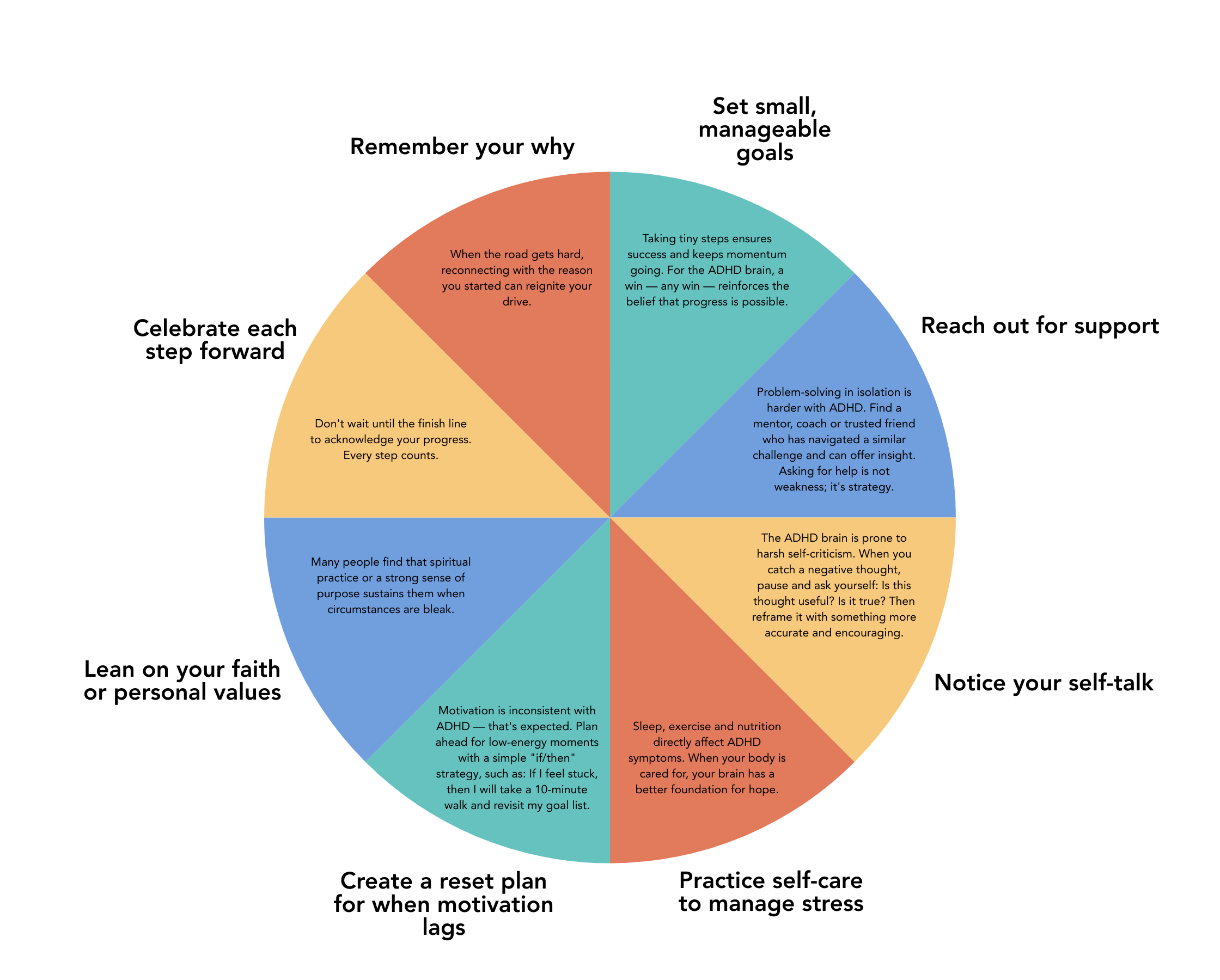
"When life becomes overwhelming, perseverance is the anchor that steadies. It is the ability to keep moving forward even when everything seems daunting and uncertain."
— Colorado Christian University
What Are the Benefits of Perseverance for People with ADHD?
All people go through challenging times, but people with ADHD are no strangers to adversity. Many of us have already developed a strong advocacy muscle — we've reached out for support for ourselves and our loved ones countless times. That's not nothing. That's resilience in action.
Persevering through difficulty develops strength and a sense of control, which is deeply empowering for a brain that often feels at the mercy of its own impulses and emotions. Over time, perseverance builds a growth mindset — the understanding that today's difficulty is an opportunity to learn, adapt and grow.
Remain hopeful and never give up. You are stronger than you think.
"If you can't fly, then run. If you can't run, then walk. If you can't walk, then crawl. But whatever you do, keep moving forward."
— Martin Luther King Jr.
Looking for Support? Start Here.
If you're navigating a difficult season and want to dig deeper into the connection between ADHD, hope and resilience, these resources are a great place to start.
For partnership in problem-solving, click here!
"What Is Hope and Why Do We Need It?" — Brian Lawlor, MD | Global Brain Health Institute (gbhi.org)
"The Fear of Failure Is Real and Profound" — William Dodson, MD | ADDitude Magazine (additudemag.com)
"Hope: A Research-Based Explainer" — Naseem Miller | Journalist's Resource (journalistsresource.org)
"How Hope Affects ADHD: Steps and Strategies to Rebuild Hope" (Episode 50, You Are a LOT Podcast) — Jen Kirkman | jenkirkman.com
"Embracing Life Challenges: Keeping the Faith During Difficult Times" | California Credit Union (ccu.com)
"Perseverance: Why It Matters and How to Develop It" | danny's-place.org
Failing Forward — John Maxwell (book)
"Three Truths About Holding on to Hope in Hard Times" — Grace Fox | gracefox.com