
Keep Your Eye on the Ball and Score Big! Small Daily Habits Lead to Big Goals—Especially If You Have ADHD!

Do you ever set goals, only to feel overwhelmed and give up because they seem impossible to achieve?
Maybe you’ve accomplished large goals, like earning a degree or landing a job, but smaller goals—like exercising, going to bed on time or even finishing the laundry—feel out of reach.
Why is reaching goals so hard when you have ADHD?
Why ADHD Makes Goals Challenging
For those of us with ADHD, time can feel abstract and elusive. We’re often so focused on the “now” that looking ahead to long-term goals feels overwhelming. Breaking down tasks into small, actionable steps—especially in the correct order—doesn’t come naturally.
Sometimes, we wait for motivation to strike, only to get frustrated with ourselves when it doesn’t. Other times, we cling to old habits, like waiting until the last minute to finish a project for the adrenaline rush. With ADHD, overwhelm often leads to procrastination, avoidance and inconsistency.
Interestingly, while ADHD traits make routines hard to build, structure and routine are exactly what help manage ADHD symptoms.
How Habits Make a Difference
James Clear, author of Atomic Habits, explains that the success of our lives is determined by the quality of our habits. He emphasizes focusing on systems (the processes we use) rather than on the end goal. Why? Because systems are the foundation for achieving outcomes.
Clear describes "atomic habits" as small, easy-to-perform routines that build momentum over time. These habits, when repeated consistently, create significant long-term results. In his words:"Good habits can make time your friend."
“Don’t worry about your goals, but rather if you have the right habits to reach your goals”
- James Clear
What Is a Habit?
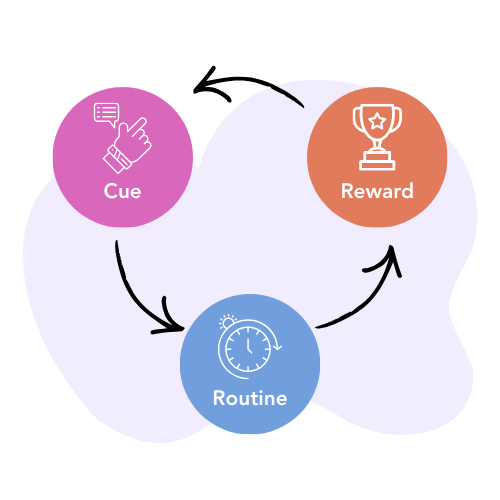
Habits are repetitive actions or behaviors that can lead to positive or negative outcomes, such as productivity, physical health or mental well-being. Psychology professor Wendy Wood explains that habits often occur in the same place daily and are prompted by cues in our environment, creating a "habit loop."
“Up to 45% of what we do daily is driven by habit.”
- Kiran McCloskey
A habit loop includes three steps:
Cue: A trigger that reminds you to act.
Routine: The behavior or habit itself.
Reward: The positive outcome that reinforces the habit.

Three Steps to Building a Habit
1. Cue: Make It Obvious
Choose a clear visual or environmental reminder to trigger the habit.
Example: If you want to exercise in the morning, lay out your workout clothes and sneakers next to your bed.
2. Routine: Start Small
Keep the habit simple and realistic to ensure success.
Example: Start with 10 minutes of walking on the treadmill rather than committing to an hour.
3. Reward: Make It Pleasurable
Reward yourself for completing the habit to reinforce it.
Example: After exercising, treat yourself to a coffee run. Rewards release dopamine, the brain’s motivation chemical, and help make habits stick.
How Long Does It Take to Form a Habit?
You’ve probably heard that it takes 21 days to form a habit. Some say it takes 21 days to form the habit and 90 days to make it part of your lifestyle.
However, research by Phillippa Lally, a health psychology researcher at University College London, found that forming a habit takes an average of 66 days. For some, it may take even longer—up to a year! This is why patience and consistency are key when developing new habits.
Four Powerful Questions to Create a Habit
What is the habit?
What is the cue?
What is the routine?
What is the reward?
Choose one small behavior to help you reach your goal. Ask yourself: What will I do, when will I do it and under what circumstances? Consistency and repetition are crucial to success.

External Supports for Building Habits
Join a Group
Being part of a community can help you forge a new identity and stay motivated. For example, joining a gym or a hiking group can help you adopt a healthier lifestyle.
Find an Accountability Partner
Organizations like ADDA (Attention Deficit Disorder Association) can connect you with accountability partners in real-time. Learn more at www.add.org.
Join a Virtual Productivity Group
Eric Tivers, ADHD coach and therapist, hosts virtual productivity groups to help you stay on track. Learn more at www.adhdrewired.com.
Work With an ADHD Coach
An ADHD coach can provide personalized strategies to help you create lasting habits. Self-awareness and understanding are key to implementing systems that work for your unique brain.
Tips for Habit Success
Start Small: Focus on making tiny, 1% improvements to build momentum.
Time It Right: Practice your new habit at the time of day when you’re most productive.
Stack Habits: Attach your new habit to an existing one (e.g., flossing right after brushing your teeth).
Be Kind to Yourself: If you miss a day, don’t give up—just start again the next day.
Focus on Progress, Not Perfection: Small steps add up over time.
Make It Fun: Interest equals focus, so find ways to make the habit enjoyable.
Eliminate Friction: Remove barriers that make the habit harder to do.
Seek Support: Reach out to groups, coaches or partners to stay accountable.
Final Thoughts: Small Habits Lead to Big Wins
Success doesn’t come from focusing on where you want to be—it comes from focusing on how to get there. Small, consistent habits add up over time, turning goals that once seemed overwhelming into achievable milestones.
It’s a journey, not a destination. So, what habit will you start today?
For hands-on support, click here to learn more!
Resources
Building Habits with ADHD: Time It Takes and How to Succeed – ADDA
Atomic Habits by James Clear – www.jamesclear.com
How Adults Can Finally Fix Their Love-Hate Relationship with Habits – Marla Cummins
What Does Dopamine Do? – Emily Guarnetta, PsyD
Instead of Waiting for Motivation, Build Habits – Ahona Guha, DPsych