
Falling Rock Zone! How to Prioritize When You Have ADHD

Do you find yourself spending all your time on busy tasks, never getting to your bigger life goals? For those of us with ADHD, prioritizing can feel overwhelming. We often struggle to break down tasks, are time-blind and face challenges with organization and planning—key executive functioning skills.
On top of that, everything can feel equally important. But is it? How can we prioritize tasks to ensure the things that matter most actually get done?
The Big Rock Theory
Stephen Covey, author of The 7 Habits of Highly Effective People, introduced the Big Rock Theory to help prioritize major life goals over less critical tasks. This theory uses a jar as a metaphor for your time and energy.
Imagine filling a jar:
Start with Big Rocks (your most important goals and values).
Then add Pebbles (secondary priorities).
Next, pour in Sand (smaller, less valuable tasks).
Finally, add Water to fill any remaining gaps.
If you start with the Sand and Water—lesser tasks—you’ll run out of space for the Big Rocks. The same applies to life: focusing on your biggest priorities first ensures they get done. Otherwise, you risk entering the dreaded “falling rock zone” where your most important goals spill over and remain undone.
Breaking Down the Jar
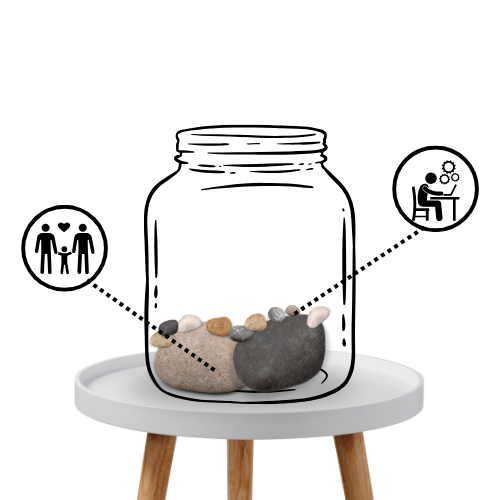
Here’s how the jar analogy works:
The Jar: Represents your available time and energy (a day, a week or even your life).
Big Rocks: Your most important, non-negotiable priorities—faith, family, health, relationships or major goals.
Pebbles: Important but less essential tasks—work, education, household chores, hobbies or property maintenance.
Sand: Smaller, low-value tasks—interruptions, scrolling social media, emails or watching TV.
Water: Optional overflow—minor tasks that can fill in leftover gaps if everything else has been prioritized.
Why the Big Rock Theory Helps People with ADHD
The Big Rock Theory is especially useful for individuals with ADHD because it:
Demonstrates Time Management: It visually shows how prioritizing tasks impacts what gets done.
Highlights Task Importance: Not all tasks are equally important, and this method helps you focus on what truly matters.
Encourages Intentionality: It helps you plan proactively instead of reacting to the chaos of smaller, less meaningful tasks.
How to Prioritize Your Big Rocks

1. Define Your Priorities:
What are your most important goals or values? Is it improving your health, spending more time with family, or pursuing career growth? Identify these Big Rocks.
2. Schedule Your Rocks:
Dedicate time to your priorities daily, weekly, or monthly. Block time on your calendar for what truly matters.
3. Plan for the Year Ahead:
Consider what’s most important to you over the next year. What goals or values will make your life more fulfilling? Focus on putting those Big Rocks in your jar first.
4. Avoid Living in the Falling Rock Zone!
No one has unlimited time. If you don’t prioritize your Big Rocks first, they won’t fit into your life at all. By focusing on what’s most important, you can avoid the overwhelm of the falling rock zone and build a life centered around what truly matters.
Avoid Living in the Falling Rock Zone!
No one has unlimited time. If you don’t prioritize your Big Rocks first, they won’t fit into your life at all. By focusing on what’s most important, you can avoid the overwhelm of the falling rock zone and build a life centered around what truly matters.
For support in identifying your priorities and creating a plan that works for your ADHD brain, click here to schedule a session.
Resources
The 7 Habits of Highly Effective People and First Things First – Stephen Covey
Big Rocks by Stephen Covey – YouTube: Avid Business Performance Group